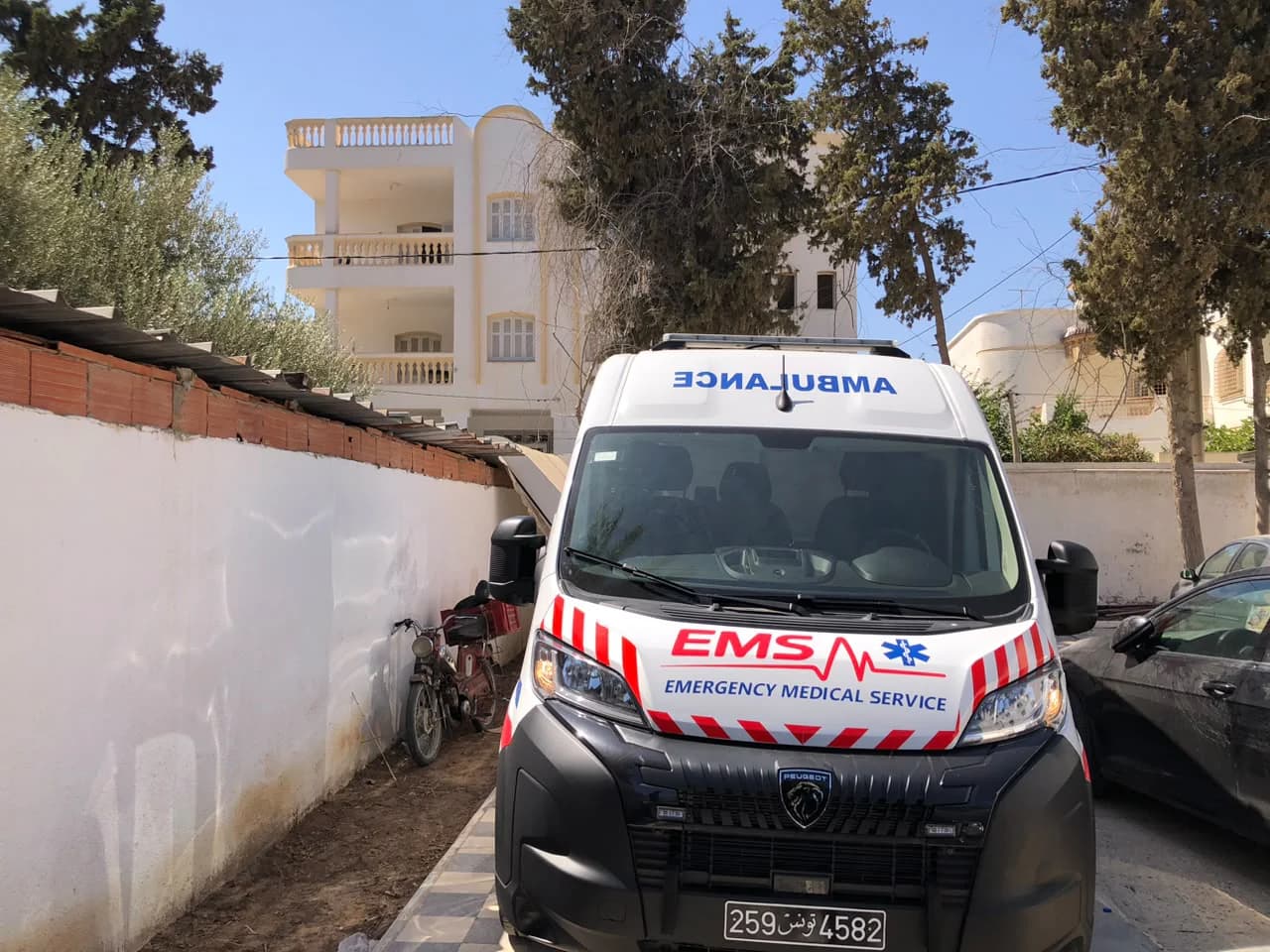
Can an ambulance get into the medina of Sfax?+
In practice, no: the lanes of the old town are too narrow for a vehicle. The ambulance parks as close as possible to a gate, whether Bab Diwan, Bab Jebli or one of the gates opened more recently, and the crew walks to the home with a transfer chair or a stretcher. Tell us the nearest gate, the floor and how wide the staircase is, and we will adapt the equipment and the number of crew members accordingly.
How long is the drive between Sfax and Monastir?+
Allow for about 130 to 150 km depending on the route, or roughly 1 h 45 to 2 h by road, not counting stops or the time needed to settle the patient. Based in Monastir, the EMS team drives this route regularly. Give us the time the patient must have arrived and we will work out the departure time from Sfax, with a margin for traffic on the way out of the city.
Can you arrange a journey home to the Kerkennah Islands?+
Yes, once we have looked at the request. The journey is built around a SONOTRAK ferry sailing between the port of Sfax and Sidi Youssef, followed by the road to the destination village. As a crossing can be cancelled in bad weather, we plan a fallback option and confirm that the journey is feasible before setting off. Tell us the village and the patient's discharge time.
Which airport should a patient travelling from Sfax use?+
It depends on the flight. Sfax-Thyna Airport, about 6 km from the city, is the most practical if it serves the destination. Otherwise, Monastir Habib Bourguiba Airport is roughly 1 h 45 to 2 h away by road, and Enfidha-Hammamet Airport around 2 h. Send us the flight number and the airline's assistance instructions so that we can plan the pick-up time.
Can EMS transfer a patient between Habib Bourguiba and Hédi Chaker university hospitals?+
Yes. This short journey between the two teaching hospitals in Sfax is prepared like any other transfer: discharging ward, receiving ward, agreement from the team taking over the patient and a contact who can be reached at each end. Also tell us about any ongoing treatment, such as oxygen or a drip, so that the crew can adapt the equipment on board.