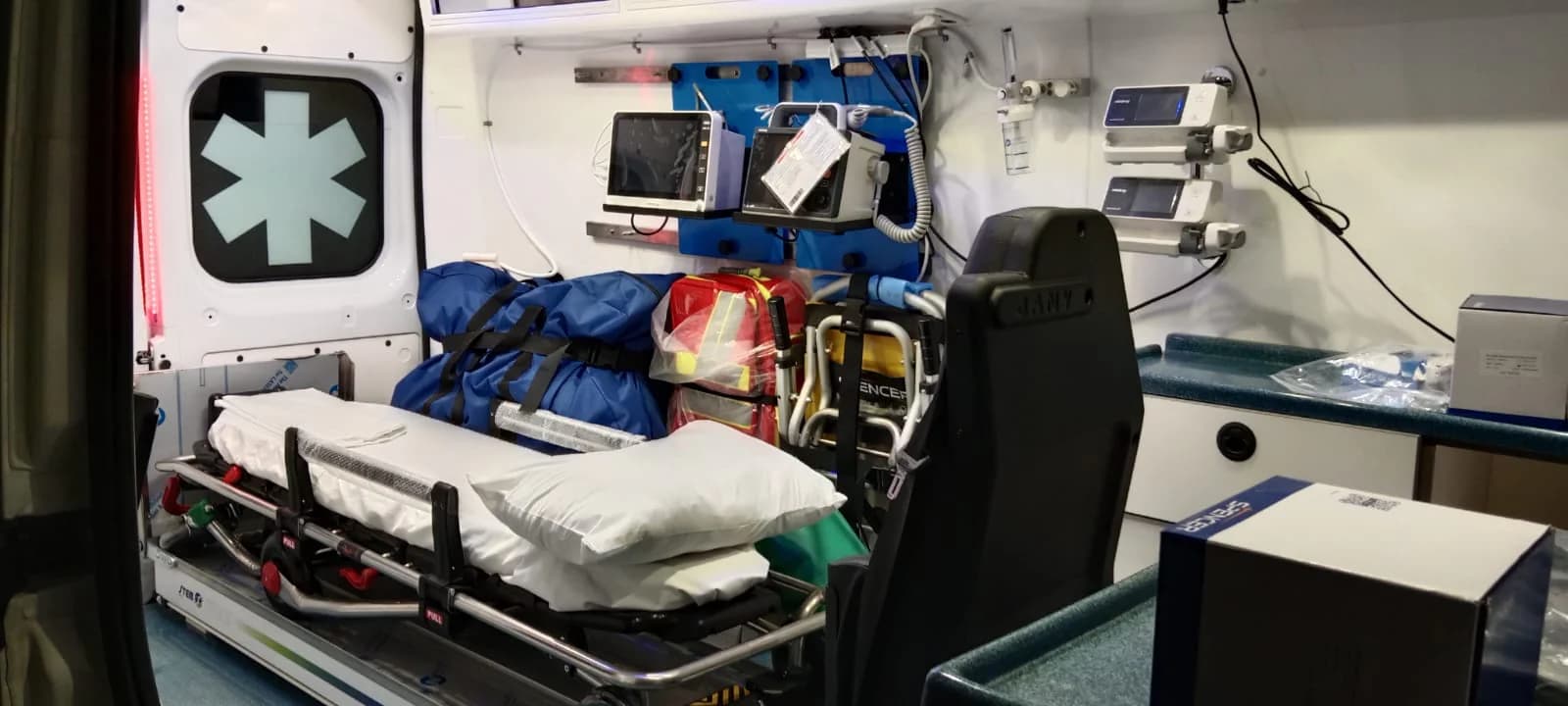
Dialysis transport in Tunisia: organising regular journeys
When dialysis sessions keep coming round, getting there becomes an organisation in its own right. What time should you leave? How do you plan the return? Who needs to be told if the centre changes an appointment? Preparing dialysis transport in Tunisia means coordinating a schedule, access arrangements and contacts, while respecting the needs agreed with the care team.
EMS organises [planned patient transport](page:transport). For regular sessions, a single grouped request makes it possible to look at several dates and anticipate the constraints of each journey. Availability and terms remain to be confirmed with EMS.
Begin by gathering the dates given by the centre, the time you need to arrive and the address of the entrance to use. The name of the facility is not always enough: a department may have a different entrance from the main reception.
Keep the arrival time requested by the centre separate from the time you leave home. EMS can work out the pick-up time, taking account of the journey and of settling the patient in. Avoid deciding on a departure time solely from the journey time shown by a route-planning app.
For several weeks of sessions, prepare a dated list rather than a general instruction such as ‘the same days as usual’. A public holiday, a rescheduled appointment or a change of centre can alter the arrangements. Have the dates actually booked confirmed.
Plan the outward and return journeys separately
A dialysis return trip means arranging two separate pick-ups. For the outward journey, the arrival time is known. For the return, ask the centre what it can tell you about when the session will end and how it lets the patient or their relative know.
Then agree the following points with EMS:
the exact place where the crew meets the patient;
the person who signals that the patient is ready to leave;
the number to use if the time changes;
the waiting and return arrangements set out in the quote.
Do not assume that the vehicle will stay on site for the whole session. This point has to be discussed when booking. If the centre announces a delay, tell EMS as soon as you know so that the return arrangements can be reviewed.
Describe needs and access before the first journey
Ask the care team which way of travelling suits the patient's condition. Then tell EMS about mobility needs: a person who can walk, help needed, a wheelchair or a stretcher. The support and resources to be provided are set before confirmation.
Also describe the route between the door and the vehicle: floor, steps, size of the lift, a narrow corridor or difficult parking. For repeated journeys, report one-off changes, for example a lift that is out of order or roadworks outside the building.
If a relative wishes to accompany the patient, ask about it when you make the request. Their presence has to be built into the journey arrangements. A need that changes between two sessions should also be reported to the team concerned before the next journey.
Choose one main contact for the schedule
When several relatives are involved in the arrangements, appoint one person to keep track of the confirmed dates and any changes. Name a second contact who can be reached if needed. This limits contradictory messages and bookings requested twice for the same session.
A simple schedule can hold five pieces of information: the date, the arrival time at the centre, the confirmed pick-up time, the contact for the return and the status of the journey. Make a clear distinction between ‘requested’, ‘confirmed’ and ‘changed’.
Keep medical information separate. Do not send a diagnosis, a medical report, a prescription or imaging through the website form or by WhatsApp. Ask EMS how to pass them directly to the team concerned when necessary.
Get the quote for regular journeys spelled out
Ask for a patient transport quote stating the dates or period concerned, the addresses, the return trips and the waiting arrangements. The price depends on the actual journey and the resources required; the fact that sessions are repeated does not mean you can assume a flat rate or a discount.
Before confirming, also check the procedure for moving or cancelling a journey, and any charges that may apply. A quote for a first journey does not automatically confirm the following ones: ask EMS to state which bookings it has accepted.
Preparing your regular dialysis transport with EMS
To organise your journeys to a dialysis centre, gather the schedule, both addresses, the mobility needs and a contact who can be reached. Contact EMS Ambulance on +216 48 024 000 to look at the options and receive a quote.
This guide covers planned journeys. In a life-threatening emergency, contact the public emergency services immediately, without waiting for a reply to a message.
In a life-threatening emergency or an acute deterioration, contact the competent public emergency services immediately. A request sent by form or WhatsApp does not confirm a transport booking.
Frequently asked questions
Can several sessions be arranged in advance?+
Yes. On its page about the ambulance in Msaken, EMS states that repeated journeys, notably for dialysis, can be planned over several weeks. Send your schedule and addresses so that the feasibility of your own route can be checked.
What if the return time is not known?+
Say so when you make the request. Agree with EMS who will announce that the patient is ready to leave and what conditions apply if there is a wait. Do not write down an assumed return time as if it were confirmed.
Is one message enough to book all the journeys?+
No. A request becomes a booking once EMS has explicitly confirmed it. Check the dates, times and conditions that have been accepted, even when the route is the same from one week to the next.